
Sarah James
2nd November 2023
AI software and proprietary technologies will change the world of engineering.
But we have a long way to go. There’s concerns around data protection, ethics and many more considerations to be had before we start to harness the true power of AI in engineering.
So, how can engineering leaders of today leverage the technology to enhance the efficiency, productivity and performance of their teams? And what needs to be considered when engineering teams utilise AI tools as part of their daily practices?
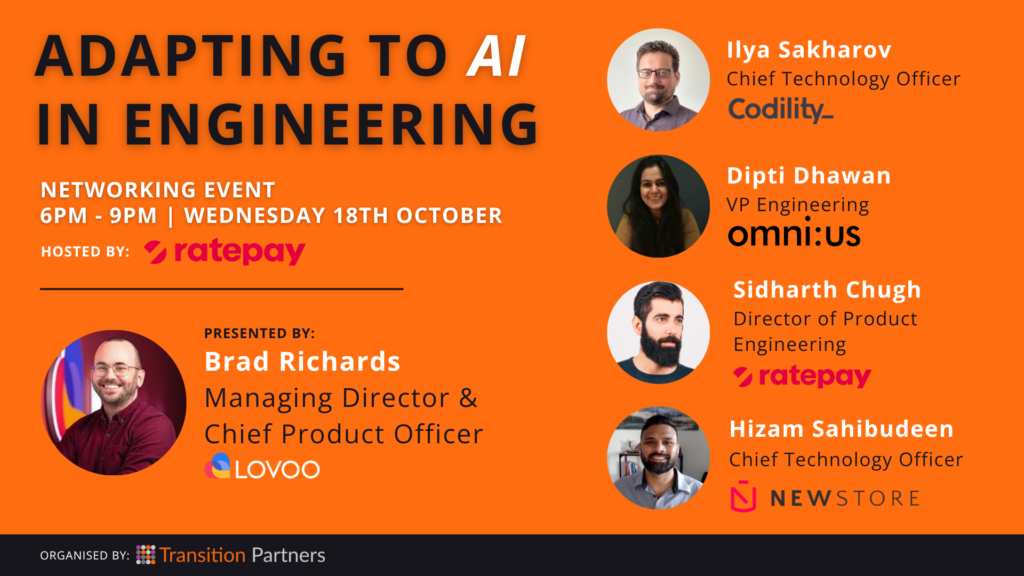
To find out, I invited four engineering leaders – plus our amazing host, Brad Richard, Chief Product Officer at LOVOO – to speak on a panel about “Adapting to AI in Engineering”. The event was attended by many more engineering experts within our Berlin network too.
There was fascinating insight shared by both the panel and the audience. In this article, I have collated my top five takeaways.
1. AI is a Productivity Game-Changer
By leveraging AI-driven tools, like Copilot, engineering teams are able to automate routine tasks.
This means engineers are able to re-focus their time on more complex and creative tasks, ultimately leading to increased efficiency and productivity – resulting in faster project completion and greater cost-effectiveness.
One of our speakers, Ilya Sakharov, who is Chief Technology Officer at Codility, provided two of his most valuable use cases for AI improving productivity.
“Firstly, our infrastructure team wanted to learn about new usage of a certain AWS service they were interested in implementing. Instead of reading 10,000 pages of awkward documentation, they got ChatGPT to provide both an explanation and the configuration files – plus anything else they wanted.
“Secondly, we use it for boilerplate code generation.”
Hizam Sahibudeen, Chief Technology Officer at Newstore, added: “We do a lot of integration with enterprise resource planning (ERP) systems and e-commerce systems, which are very well defined.
“Whether you’re using Copilot or Code Whisperer or whatever, tools like this are able to give you the right code to interface with these systems. So it works really, really well.
“If you think of what most people do these days – unless you’re very specialised in writing complex, algorithmic subsystems from scratch – most of the time you’re copying from Stack Overflow or Google.
“Now I don’t have to go to an application to get the codes I want to cut and paste. Instead, I get it directly in my code. So, it’s not really that different. It’s just helping me work faster.”
The point was widely agreed by the panel who have used AI to efficiently analyse data, refine product designs using simulations and modeling, quickly prototype innovations and more.
2. Convincing Stakeholders & Proving ROI
The efficiency and productivity benefits are clear, but one of our audience members raised an interesting point: “How do I get sign-off for investment in AI from my CFO. They want to see the return on investment (ROI). They want to see figures and productivity metrics.”
The discussion quickly turned to DevOps Research and Assessment (DORA) metrics.
Ilya explained that “if you see the decrease in lead time to change and increase in deployment frequency, then you’ve got your ROI to show the CFO.”
Dipti Dhawan, VP Engineering at Omni:us, also advised that you look at your tech debt.
“A good way for you to show the impact of tools, like Copilot, will be in the reduction of your tech debt. That will be a key factor to help you win over stakeholders and at least start to make adoption changes incrementally.”
3. Should Junior Developers Be Worried?
So, we’re using AI effectively and stakeholders are invested in it… but isn’t it displacing the roles of our junior developers?
With AI’s ability to handle routine and repetitive coding tasks, which were once common for junior developers, there has been concerns that the technology will disrupt their development or even render them redundant to businesses.
However, Hizam and other members of our panel argued that advancements in AI might be to the advantage of junior developers.
“If the junior developers are doing mundane work that should be automated, they shouldn’t be there. So, I think what’s going to happen is that junior developers who are well versed with all these tools are going to be much more productive. I also think juniors are more likely to adapt to using AI in comparison to senior developers, who will almost have to relearn the way they work.”, said Hizam .
With AI is transitioning the practices of engineering professionals, our conversation moved onto the future skills required to be successful in the role. Ilya believed this is also an area of the space that is being impacted by the rise of the technology.
“AI lowers the entry bar significantly, making mundane code generation skills less of a necessity. This will leave space for real engineering skills, like problem solving and finding solutions. And this is where the real talent will shine or fail”, said Ilya.
As a talent consultant who specialises in tech, it’s been fascinating to see different mindsets develops among hiring managers. This isn’t to say that everyone in the room agreed with Ilya. However, it is certainly an opinion that is becoming more and more popular with engineering leaders.
4. Re-Thinking Your Hiring Process
So, with AI impacting what makes a successful engineering professional, it is naturally impacting hiring trends and interview processes.
In technical challenges, ‘how’ candidates arrive at a solution is becoming less important. What is valued is their ability to solve the challenge and achieve the desired outcome efficiently.
Dipti was and is keen to embrace this change, saying: “How do you write code? It’s not important. It’s important on how you get to the part of understanding the problem. So, the whole code generation part is really in the background.”
Dipti is right. If writing code is a skill that’s becoming less of a necessity, then the interview and hiring process should be focused more on understanding how candidates approach problems and collaborate with their team. That’s because real outcomes are still driven by human ingenuity.
5. Data Ethics, Protection & the Future
While there are many advantages to using AI, there are concerns about data protection and ethics.
Sidharth Chugh, Director of Product Engineering at Ratepay (who hosted the event) warned to be cautious about your use of AI, particularly when handling confidential data:
“We don’t use ChatGPT for many things. Our Data Protection Officer doesn’t like it.
“You have to be really careful about what data you are sharing and how it will be or is used. Also from data protection point of view, you need to ask yourself: ‘who are the actual users of this?’”
Dipti agreed that AI and data privacy is “murky ground”. However, she added that the upcoming AI EU Act should improve transparency and accountability – with the act giving Brussels the power to shut down services that cause harm to society.
It’s fascinating how this is going to play out. AI is transforming engineering by boosting efficiency and productivity. It empowers junior developers and encourages problem-solving skills. However, concerns about data privacy and ethics are real.
If you’d like to share your thoughts, provide feedback about this article, or get in touch about being a future speaker for our events; I’d love to speak with you.
You can connect with me on LinkedIn here and my email is sarah.jamesoc@transition-partners.co.uk.